
Dr. Tenley Lawton specializes in breast lifts and other breast surgeries, and she often performs breast augmentations and breast lifts at the same time. For many people, neither procedure will solve the person’s breast concerns on their own but combined, they can achieve the desired results.

The Ultimate Guide to Facial Plastic Surgery for Men
What Is Driving the Rise in Facial Plastic Surgery for Men?
Facial plastic surgery for men encompasses customized structural procedures—such as blepharoplasty, rhinoplasty, neck lifts, and deep plane facelifts—designed to preserve masculine anatomy and deliver discreet rejuvenation. These procedures address heavy upper eyelid hooding, nasal irregularities, jowls, and neck laxity while maintaining strong, natural male features.
Several key cultural and professional factors explain why more men are exploring facial plastic surgery:
- The “Zoom Effect” and Digital Scrutiny: High-definition video conferencing, digital client presentations, and social media platforms have made men hyper-aware of how they look under harsh overhead lighting and front-facing cameras. Shadows under the eyes, a softening jawline, or heavy neck laxity become immediately obvious on screen.
- Workplace Competitiveness and Longevity: In an increasingly job market, seasoned professionals often find themselves competing against younger colleagues. Looking chronically exhausted, stressed, or weathered can be an unwanted liability. Men seek facial rejuvenation not to look like a teenager, but to maintain a sharp, vital, and competitive edge.
- The Demystification of “Man-Esthetics”: The cultural stigma once attached to male self-care has dissipated. Modern men view grooming, physical fitness, nutrition, and aesthetic procedures as interconnected pillars of personal health and wellness.
- A Shift Toward Preventative, Structural Refinement: Rather than waiting until severe facial laxity requires a radical overhaul, men are proactively addressing early changes in their 30s, 40s, and 50s. The goal is subtle maintenance—retaining masculine character while erasing signs of premature aging.
Men approach aesthetic surgery with very specific expectations. They rarely want dramatic reinvention; instead, their priority is discretion. A successful male procedure delivers results where colleagues and friends comment that they look exceptionally well-rested or fit, without ever suspecting surgery took place.
How Does Male Facial Aging Differ from Female Aging?
Achieving an undetectable result in male facial surgery requires a profound understanding of male facial anatomy. Men do not age in the same way women do, and applying female surgical techniques to a man’s face is the single most common cause of feminized or unnatural outcomes.
Male skin is approximately 25% thicker than female skin due to higher collagen density and testosterone-driven dermal architecture. Men also have a richer blood supply (increased vascularity) and more active sebaceous glands. While this gives men better skin elasticity in their younger years, it means that when facial tissues eventually descend, they do so with greater weight. This produces heavier jowls, deeper nasolabial folds, and more pronounced platysmal neck banding.
Male facial skeletons feature distinct structural markers: prominent supraorbital ridges (brow bones), lower and flatter eyebrow positions, wider cheekbones, and square, well-defined chins. Softening these angles or over-elevating the brows inevitably creates a feminized appearance. Furthermore, male pattern baldness, thinning hair, and beard-bearing skin dictate that surgical incisions must be planned with surgical artistry to remain completely invisible.
| Anatomical Feature | Male Facial Characteristics | Female Facial Characteristics | Surgical Design Implication for Men |
|---|---|---|---|
| Dermis & Subcutaneous Tissue | Thicker, denser collagen, higher vascularity | Thinner, softer dermal architecture | Requires meticulous blood pressure control and robust deep-layer structural support |
| Brow & Upper Orbital Rim | Heavy brow bone; low, horizontal eyebrow | Arched, higher eyebrow above orbital rim | Brow lifts must avoid high arches; blepharoplasty must preserve natural brow fullness |
| Lower Face & Jawline | Wide mandibular angle, square chin contour | Softer, tapered, heart-shaped jawline | Deep-plane vectors must restore sharp, angular jaw borders rather than narrow contours |
| Hair & Beard Distribution | Sideburns, neck beard, potential crown balding | Stable hairline, finer hair follicles | Incisions must be designed to avoid pulling beard hair into the ear canal or leaving visible scars |
| Neck Laxity Patterns | Heavy platysma bands, thick subplatysmal fat | Thinner skin, superficial fat accumulation | Demands comprehensive subplatysmal sculpting and muscular redraping |
What Are the Most Popular Facial Plastic Surgery Procedures for Men?
Men seeking facial plastic surgery have distinct aesthetic goals that require customized techniques. In our practice, we focus on identifying the specific structural changes contributing to a tired or aged appearance. Men frequently choose from the top cosmetic procedures for men to achieve balanced, long-lasting facial harmony.
Male Blepharoplasty (Eyelid Surgery)
The eyes are typically the first area to show fatigue and age. In men, excess upper eyelid skin can cause heavy “hooding” that obscures the eye, impairs peripheral vision, and imparts a stern, exhausted look. In the lower eyelids, weakening tissue allows orbital fat pads to herniate forward, creating chronic dark circles and puffy under-eye bags.
Male blepharoplasty differs substantially from eyelid surgery for women:
- Upper Eyelid Refinement: We perform conservative skin and fat excision. Removing too much tissue creates a hollowed, sunken orbit or raises the eyelid crease too high, which feminizes the eye. The goal is to clear the heavy shelf of redundant skin while maintaining a masculine lid contour.
- Lower Eyelid Rejuvenation: We typically utilize a transconjunctival approach (placing the incision inside the lower lid) to reposition or conservatively contour herniated fat pads. This prevents visible external scars and eliminates puffiness without altering the natural eye shape.
- Preserving Brow Architecture: A man’s eyebrow naturally rests lower, directly on the orbital rim. We ensure that adjacent tissues are not over-elevated, preserving an authoritative, masculine gaze.
Male Rhinoplasty
A man’s nose anchors his entire facial profile. Men seeking rhinoplasty surgery often want to correct a prominent dorsal hump, repair structural asymmetry caused by sports injuries, or refine a bulbous tip, all while preserving strength and character.
Male rhinoplasty requires preserving a straight, strong nasal dorsum with a well-defined tip that forms an approximate 90-to-95-degree angle with the upper lip. Narrowing the bridge excessively, scooping the profile, or creating an upturned nasal tip produces an unnatural, operate-on look. In many cases, we combine cosmetic refinement with functional septoplasty to open obstructed airways and improve breathing.
Neck Lift and Jawline Rejuvenation
A defined jawline is the universal hallmark of male facial vitality. As tissue laxity progresses, the descent of facial fat pads and the loosening of the platysma muscle lead to jowling, submental fullness (“double chin”), and vertical “turkey neck” bands that obscure the mandibular border.
A dedicated neck lift surgery restores an acute, sharp cervicomental angle (the transition between the chin and the neck). Through a hidden incision beneath the chin and behind the ears, we:
- Remove superficial and deep subplatysmal fat deposits.
- Tighten and re-approximate the separated edges of the platysma muscle (platysmaplasty).
- Redrape the skin cleanly over the underlying framework to define the jawline from chin to earlobe.
Chin Augmentation and Facial Contouring
A weak or receding chin (microgenia or retrognathia) disrupts overall facial proportion, making the nose appear disproportionately large and worsening the appearance of neck laxity.
When evaluating options, men often weigh chin implants versus dermal fillers to determine the right path. While temporary dermal fillers provide a non-surgical preview of added projection, a custom anatomical silicone chin implant offers a permanent, structural solution that widens and projects the lower face.
For men who have experienced volume loss across the temples, midface, or tear troughs, we utilize micro-droplet facial fat grafting. By harvesting a small amount of unwanted fat from the abdomen or flanks, purifying it, and meticulously injecting it into deep structural planes, we restore youthful facial architecture without the puffiness sometimes associated with large volumes of synthetic filler.
Non-Surgical Treatments and “Brotox”
For men not yet ready for surgery, non-invasive treatments provide significant preventative and restorative benefits. Neuromodulator treatments—popularly dubbed “Brotox”—are tailored specifically for male muscle dynamics.
Because men have substantially larger, stronger facial muscle mass than women, they require specialized dosing strategies. When performing wrinkle correction treatments for men, our injection placement focuses on relaxing deep dynamic furrows between the brows (glabella) and across the forehead while leaving enough subtle movement to preserve natural expressions.
Complementary medical-grade skin rejuvenation for men is equally vital to address environmental damage:
- Fractional Laser Resurfacing: Improves sun damage, coarse skin texture, and deep wrinkles around the mouth and eyes.
- IPL (Intense Pulsed Light): Clears broken capillaries, facial redness, and hyperpigmented age spots caused by outdoor sun exposure.
- RF Microneedling: Stimulates collagen synthesis to tighten mild skin laxity and refine enlarged pores.
- Medical-Grade Skincare: Targeted daily regimens featuring clinical antioxidants, retinoids, and broad-spectrum SPF designed for thicker, oilier male skin.
How Are Male Facelifts Customized to Preserve Masculine Features?
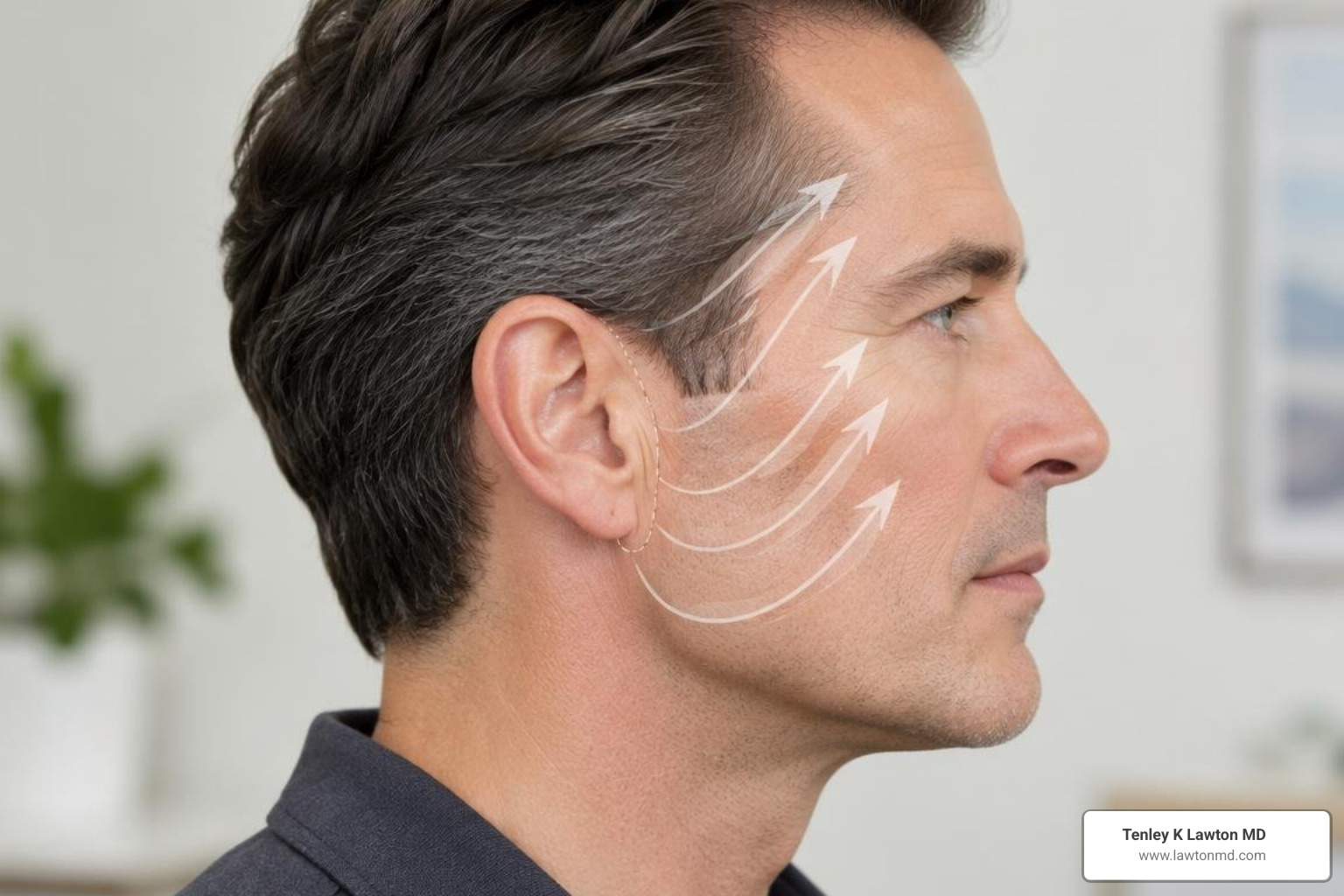
A traditional facelift technique that relies heavily on pulling and trimming surface skin can be disastrous for a male patient. Pulling skin too tightly flattens natural facial contours, distorts the earlobes (creating a “pixie ear” deformity), and shifts sideburns unnaturally backward.
According to an analysis on male aesthetic procedures by the American Society of Plastic Surgeons, the surgical philosophy for men must prioritize deep anatomical support rather than surface tension Beyond the facelift: How facial plastic surgery is changing for men.
The Deep Plane Facelift Advantage for Men
The gold standard in male facial rejuvenation is the deep plane facelift. Rather than separating the skin from the underlying tissue and pulling the skin taut, the deep plane technique enters the anatomical space beneath the Superficial Musculoaponeurotic System (SMAS).
In this deep anatomical plane, the surgeon directly releases the true facial retaining ligaments (the zygomatic, masseteric, and mandibular ligaments) that tether aging tissues down. Once these ligaments are released, the deep muscular structure, fallen cheek fat compartments, and heavy jowls can be elevated vertically and repositioned without placing any tension on the surface skin.
For men, the deep plane technique provides profound advantages:
- Supports Heavier Tissues: Male facial tissues are thick and heavy; lifting them from the deep structural plane prevents early recurrence of sagging.
- Completely Eliminates the “Pulled” Look: Because the lifting force is borne entirely by the deep fascia and muscle, the surface skin is simply redraped with zero tension.
- Exceptional Longevity: Modern deep plane facelift surgery delivers long-lasting outcomes that typically endure for 10 to 15 years.
- Seamless Neck Integration: For patients with significant lower face and neck aging, combining a neck lift and facelift creates a crisp, continuous contour from the midface down to the clavicles.
Incision Design and Scar Concealment in Men
Incision placement in male facelifts requires exceptional precision due to hair-bearing skin and shorter hairstyles.
- Sideburn and Temple Preservation: In women, incisions can easily be tucked into the temple hair. In men, doing so can elevate or distort the sideburns, moving them behind the ear. We design incisions that trace along the natural anterior border of the sideburn, preserving its exact location and natural growth pattern.
- Pre-Tragal vs. Retro-Tragal Placement: In female patients, incisions are often placed behind the tragus (the small cartilage flap in front of the ear canal). In men, placing an incision behind the tragus can pull hair-bearing beard skin directly onto the ear cartilage, requiring the patient to shave inside their ear. We frequently place the incision in the natural pre-tragal crease in front of the ear, where it heals as an imperceptible fine line without translocating beard follicles.
- Behind the Ear and Neckline: The incision continues around the earlobe, hugs the posterior sulcus behind the ear, and extends into the posterior hairline or along the hair margin, ensuring it remains undetectable even with short, tapered haircuts.
What Should Men Expect During Recovery and Healing?
Understanding the recovery timeline helps men plan their procedure discreetly around professional and personal commitments.
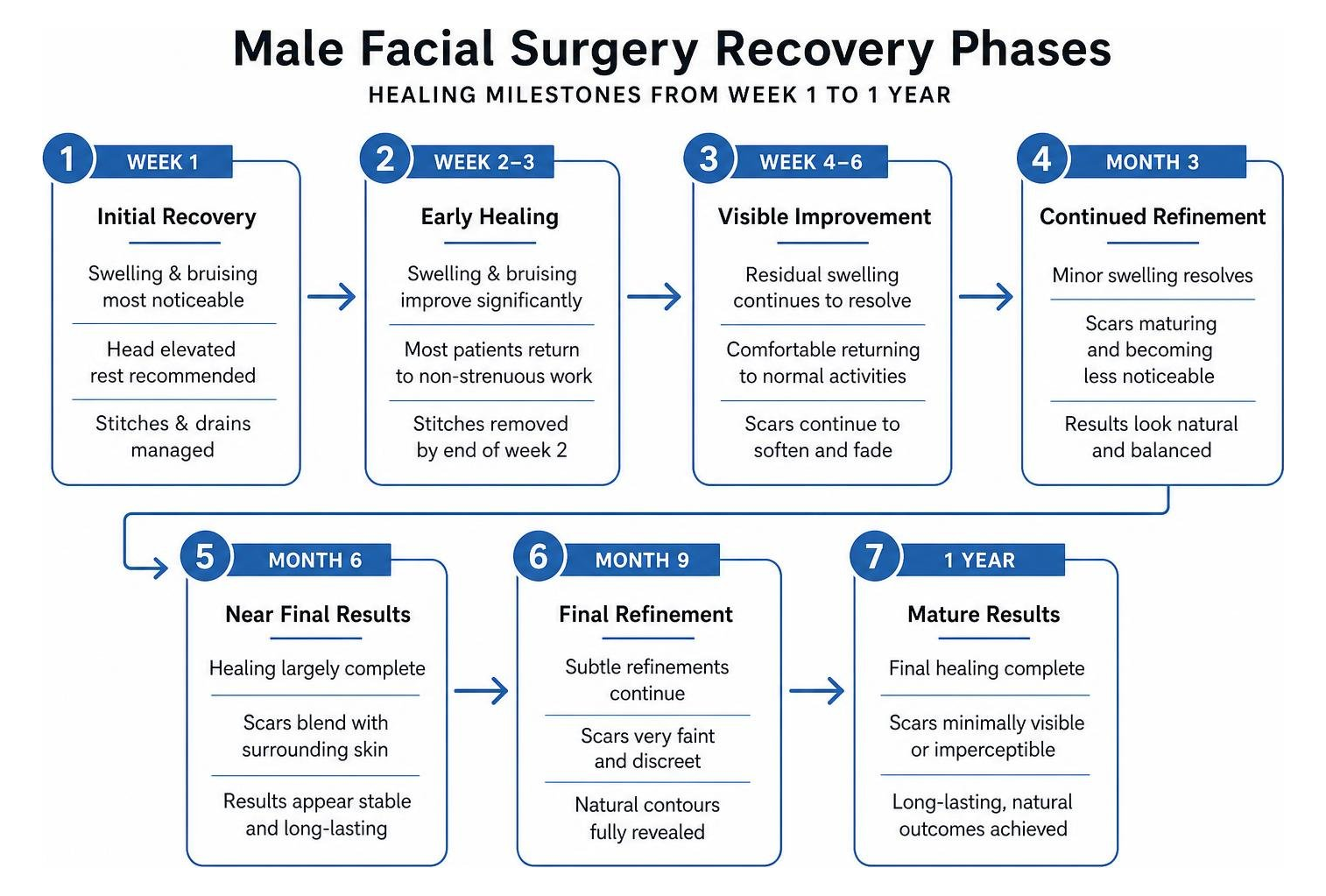
The Immediate Post-Operative Period (Days 1–3)
Following surgery, a light supportive head wrap is applied. Some patients may have small, temporary surgical drains placed behind the ears to prevent fluid accumulation, which are typically removed within 24 to 48 hours.
Because men have higher baseline vascularity and blood pressure, strict blood pressure control is paramount during the first 72 hours to minimize bruising and eliminate the risk of a hematoma (a localized collection of blood beneath the skin). We provide detailed medications and protocols to ensure pain management, low resting blood pressure, and effortless recovery in a head-elevated position.
Week 1: Initial Healing and Rest
Discomfort is typically modest and managed easily with prescribed medication for the first few days, quickly transitioning to over-the-counter options. Swelling peaks around day three and begins subsiding. Most sutures are removed between days six and eight. Patients are encouraged to take light walks around the house to promote circulation, though bending over, straining, and heavy lifting are strictly prohibited.
Weeks 2 to 3: Resuming Professional Work
By day 10 to 14, the vast majority of visible bruising has faded, and residual swelling is generally subtle enough that casual observers will not notice it. Most men working in executive, desk-based, or remote roles comfortably return to work at the two-week mark. If needed, subtle mineral-based camouflage can neutralize any residual yellowing skin tones.
Weeks 4 to 6: Return to Active Exercise
By week four, tissues have stabilized significantly. Light cardiovascular workouts (stationary cycling, walking on an incline) can resume. By weeks five to six, men receive full clearance to return to intense weight training, running, golf, tennis, and contact sports.
Long-Term Maturation (Months 3 to 12)
While patients look refreshed and public-ready by week three, subtle internal healing continues. Residual micro-swelling around the jawline and neck fully resolves over three to six months, revealing crisp, sharp mandibular contours. Incision lines gradually mature from faint pink marks into soft, pale lines that blend invisibly into natural skin creases.
Frequently Asked Questions About Facial Plastic Surgery for Men
At What Age Do Men Typically Get Facial Plastic Surgery?
There is no single “right” age for facial rejuvenation; candidacy is determined by anatomical changes rather than chronological age:
- 30s and Early 40s: Men commonly seek structural procedures such as rhinoplasty, chin augmentation, buccal fat refinement, and non-surgical maintenance (“Brotox”, dermal fillers, and laser skin resurfacing) to address genetic features or early skin laxity.
- Mid-40s to 50s: This is the most common timeframe for men to undergo blepharoplasty (eyelid surgery), submental neck sculpting, and deep plane midface/lower facelifts as early jowls and neck banding emerge.
- 60s and Beyond: Mature men pursue comprehensive deep plane facelifts, platysmaplasty neck lifts, and upper/lower blepharoplasty to restore structural definition and eliminate advanced tissue laxity.
Will a Facelift or Blepharoplasty Make Me Look “Overdone” or Unnatural?
When performed by a board-certified plastic surgeon experienced in male aesthetic architecture, the answer is an emphatic no. The “windswept,” over-tightened, or feminine look occurs only when an inexperienced surgeon relies on outdated superficial skin-pulling techniques or applies female aesthetic vectors to a male face.
By restoring the deep structural SMAS layer, releasing retaining ligaments, and redraping the skin tension-free, a modern male facelift restores the crisp angles of youth while preserving every ounce of rugged, masculine character.
How Long Do the Results of Male Facial Rejuvenation Last?
A deep plane facelift and neck lift resets the anatomical clock by approximately 10 to 15 years. While surgery does not stop the natural biological aging process, you will always look significantly younger and more rested than you would have without the procedure.
To maximize the longevity of your results:
- Maintain a stable body weight (avoiding drastic fluctuations).
- Wear broad-spectrum daily sunscreen to preserve dermal collagen.
- Avoid smoking and nicotine products, which impair microvascular circulation.
- Maintain skin health through periodic non-surgical treatments and clinical skincare.
How Can Men Choose the Right Surgeon for Natural Results?
Choosing the right plastic surgeon is the single most critical decision you will make in your aesthetic journey. Because male facial surgery demands a fundamentally different approach than female surgery, you should seek a surgeon who demonstrates a nuanced command of male anatomy and aesthetics.
When vetting plastic surgeons:
- Verify Board Certification: Ensure your surgeon is certified by the American Board of Plastic Surgery (ABPS).
- Examine Male Before-and-After Portfolios: Review extensive photographic examples of male patients. Look specifically for natural earlobe shapes, preserved sideburns, invisible incision lines, and crisp, strong jawlines that do not appear overly pulled.
- Evaluate Surgical Philosophy: During your consultation, your surgeon should listen closely to your goals, assess your facial anatomy in detail, and explain precisely how their surgical approach will preserve your masculine features.
At Tenley K Lawton MD in Newport Beach, California, we believe that exceptional plastic surgery should never announce itself. Our practice is built on the pillars of personalized compassionate care, anatomical precision, and patient empowerment. We understand the discretion and subtlety required by our male patients, tailoring every surgical and non-surgical treatment to deliver sharp, rested, and completely natural results.
If you are ready to explore how modern facial plastic surgery can restore your jawline, refresh your eyes, and enhance your confidence, we invite you to schedule a private consultation with our team.